The success of any custom hardware project begins long before the first piece of metal is cut on the factory floor; it begins during the Design for Manufacturing (DFM) phase with raw material selection. Choosing the correct sheet metal alloy will determine your product's structural integrity, weight, thermal conductivity, corrosion resistance, and ultimately, its unit cost. Specifying an over-engineered material wastes procurement budget, while under-specifying can lead to catastrophic field failures.
With hundreds of distinct metal alloys and tempers available on the industrial market, engineers must carefully balance physical properties against fabrication limits. Some metals are incredibly strong but will crack instantly when bent on a press brake. Others are highly conductive but notoriously difficult to weld. In this comprehensive engineering guide, we will break down the exact specifications, advantages, and ideal applications for the most common materials used in modern sheet metal fabrication.
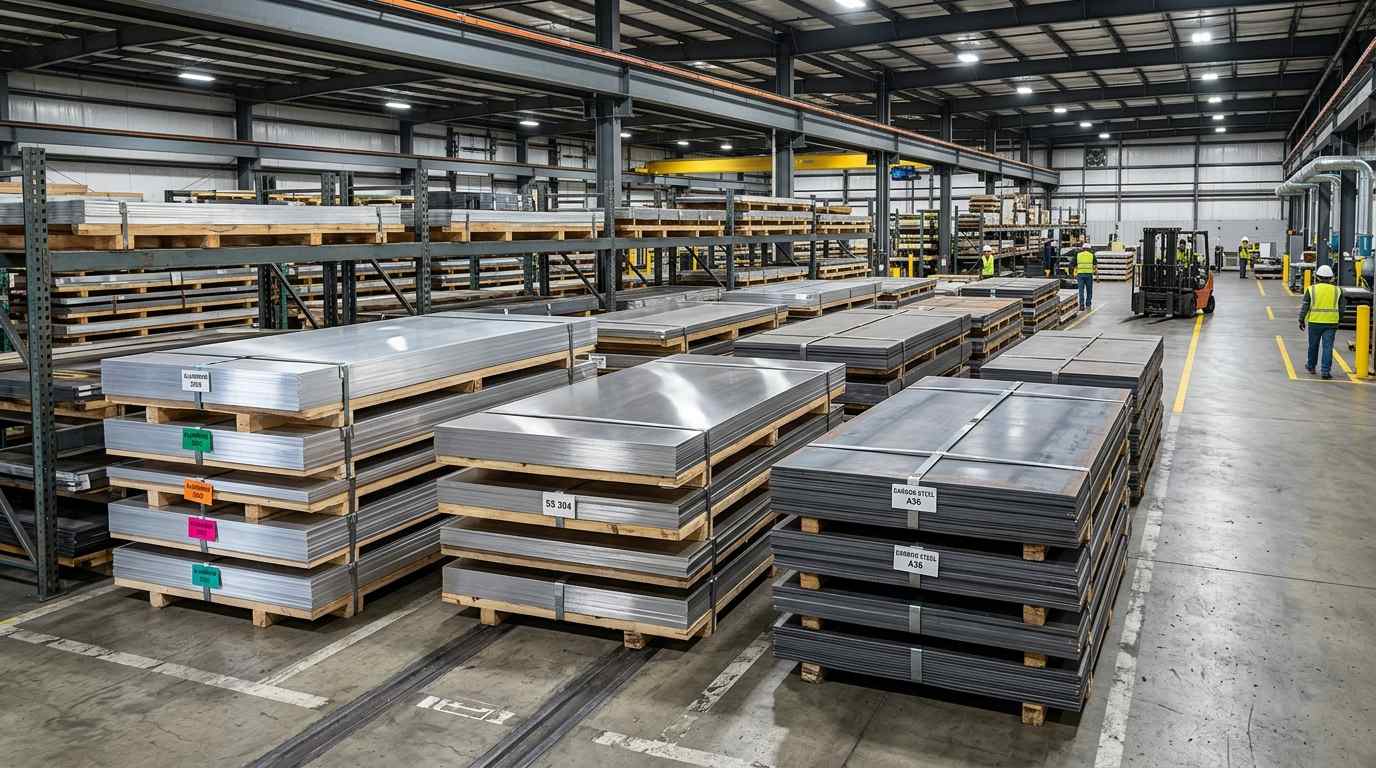
Cold Rolled Carbon Steel (CRS / SPCC): The Industry Workhorse
Cold Rolled Steel (CRS) is essentially hot rolled steel that has undergone further processing at room temperature. This additional processing yields a material with tighter dimensional tolerances, a smoother surface finish, and increased tensile strength. It is the most economical and widely used material in the sheet metal industry.
The Advantages: CRS is highly formable, making it exceptionally easy to cut, punch, bend, and weld. Because of its excellent structural rigidity and low raw material cost, it is the default choice for indoor applications, such as internal brackets, IT server racks, and consumer appliance housings.
The Disadvantages: The primary weakness of raw carbon steel is its high susceptibility to oxidation (rust). When exposed to ambient moisture, it will begin to rust almost immediately. Therefore, any product manufactured from CRS must undergo a secondary surface treatment—typically a primer layer followed by a thick powder coating—to seal it from the environment.
Galvanized Steel (SGCC / SECC): Cost-Effective Protection
To solve the corrosion problem of standard carbon steel without jumping to the high cost of stainless steel, manufacturers utilize galvanized or galvannealed steel. This is standard carbon steel that has been coated with a microscopic layer of zinc.
The Advantages: The zinc coating acts as a sacrificial anode. Even if the part is scratched deeply enough to expose the underlying steel, the surrounding zinc will oxidize first, preventing the rust from spreading. This built-in corrosion resistance makes it a highly popular material for outdoor utility boxes, HVAC ducting, and automotive components.
The Disadvantages: While galvanized steel offers great rust protection, it is notoriously difficult to weld. The intense heat of TIG or MIG welding vaporizes the zinc coating, releasing toxic zinc oxide fumes (which is dangerous for operators) and destroying the corrosion protection at the weld seam. If your assembly requires heavy welding, galvanized steel is generally not recommended unless mechanical fastening (riveting or clinching) is used instead.
Stainless Steel (304 & 316): Extreme Durability
When absolute corrosion resistance is required—without relying on paint or powder coating—stainless steel is the ultimate solution. The secret lies in its chemical composition, which includes a minimum of 10.5% chromium. This chromium reacts with oxygen to form an invisible, self-healing passive layer that blocks moisture.
The Advantages: Type 304 stainless steel is the most common, offering excellent strength and chemical resistance for food processing equipment and medical devices. Type 316 takes it a step further by adding molybdenum, which specifically prevents pitting corrosion from chlorides (salt). If you are engineering Industrial Stainless Steel Cabinets for maritime deployment or offshore oil rigs, 316 stainless steel is the mandatory industry standard.
The Disadvantages: Stainless steel is expensive. Furthermore, it is incredibly tough and work-hardens quickly. This means it puts immense wear and tear on CNC punching tools and requires significantly more tonnage (force) from a press brake to fold compared to mild steel. Fabricators must factor these increased machining and tooling costs into the final unit price.
Aluminum Alloys (5052 & 6061): Lightweight and Conductive
As the demand for lightweight hardware surges in the aerospace, electric vehicle (EV), and telecommunications sectors, aluminum has become heavily utilized. It is approximately one-third the weight of steel while offering excellent natural corrosion resistance.
The Advantages: Beyond its low density, aluminum is highly conductive, making it an excellent choice for thermal management (heat sinks) and EMI/RFI shielding. When manufacturing Custom Aluminum Enclosures, engineers generally specify the 5052-H32 alloy. 5052 is highly formable and can endure tight 90-degree bends without cracking along the grain.
The Disadvantages: A common DFM mistake is specifying the 6061-T6 aluminum alloy for sheet metal parts. While 6061 is excellent for CNC milling due to its hardness, it is incredibly brittle in sheet form and will violently crack if folded on a press brake. Additionally, aluminum is notoriously difficult to weld (requiring specialized AC TIG machines) and has lower overall tensile strength than steel, making it susceptible to denting under heavy impact.
Copper and Brass: The Electrical Champions
While rarely used to construct the outer housing of an enclosure due to its extreme weight and high cost, copper is indispensable inside the cabinet. Copper offers the highest electrical and thermal conductivity of any commercial sheet metal.
Ideal Applications: It is almost exclusively used to manufacture heavy-duty electrical busbars, grounding straps, and highly specialized heat exchangers. Brass (an alloy of copper and zinc) is occasionally used for highly aesthetic architectural components or specialized anti-sparking environments, though its structural use in standard hardware is limited.
Partnering with a DFM-Focused Manufacturer
Choosing the right sheet metal is a complex balancing act between environmental demands, mechanical strength, and manufacturing budget. Specifying the wrong alloy can lead to cracked bends during production or severe corrosion once deployed in the field.
At Huapusheng, our engineering team acts as an extension of your R&D department. We provide comprehensive Precision Sheet Metal Fabrication services, processing everything from lightweight 5052 aluminum to high-tensile 316 stainless steel. Before we cut a single sheet of metal, we analyze your CAD drawings to ensure the specified materials and gauges are optimized for cost-efficiency and flawless structural performance. Contact us today to review the material strategy for your next mass production run.
Frequently Asked Questions
Can laser cutters process highly reflective materials like copper?
Historically, older CO2 lasers struggled with copper and brass because the laser beam would reflect off the metal and damage the machine's optics. However, modern high-power fiber lasers operate at a different wavelength and can cut highly reflective metals like copper and aluminum with extreme precision and speed.
What is the difference between 304 and 316 stainless steel?
While both are highly corrosion-resistant, 316 stainless steel contains the addition of molybdenum. This chemical element drastically increases the metal's resistance to pitting corrosion caused by chlorides, making 316 the mandatory choice for marine environments, coastal regions, and chemical processing plants.
Why did my aluminum sheet metal crack during bending?
Aluminum cracking is almost always caused by specifying the wrong alloy temper or forcing too tight of a bend radius. The 6061-T6 alloy is excellent for machining but notoriously brittle for bending. For sheet metal folding, engineers should always specify the more ductile 5052-H32 alloy and adhere to a minimum inside bend radius of 1T (one times the material thickness).